

Acrylic pipes are frequently ordered for prototypes, display systems, lighting features, laboratory equipment, decorative installations, and transparent enclosures. Despite their apparent simplicity, small specification errors can result in unsuitable material, machining difficulties, weak joints, or costly remanufacturing.
Buyers evaluating an Acrylic Pipe Manufacturer should identify these common procurement mistakes before confirming an order.
Treating Outer Diameter as the Only Important Dimension
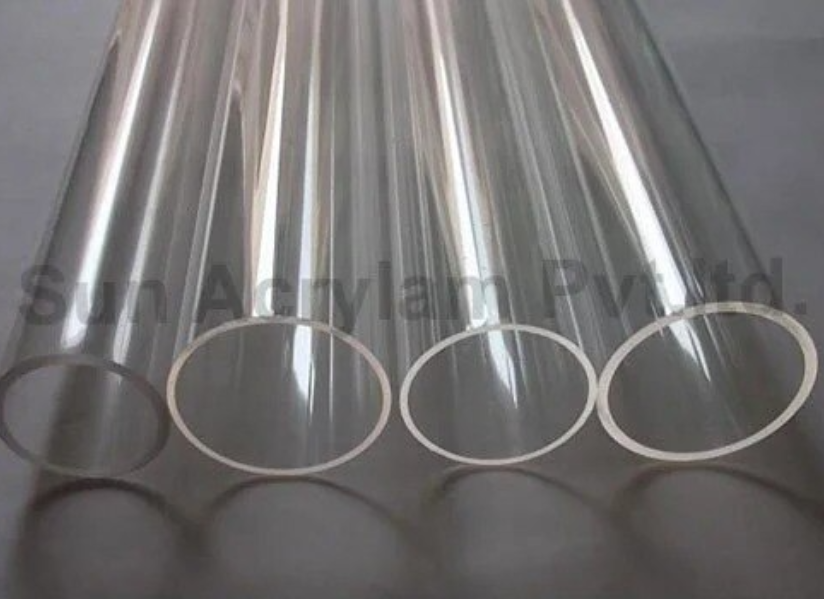
Two pipes with the same outer diameter may have different inner diameters and wall thicknesses. This affects weight, rigidity, flow capacity, machining allowance, and joint compatibility.
A complete specification should include:
- Outer diameter
- Inner diameter
- Wall thickness
- Length
- Dimensional tolerance
If the pipe must fit another component, state whether the critical dimension is internal or external. Providing a drawing is safer than relying on a verbal description.
Ignoring Pressure and Structural Conditions
Transparent appearance does not indicate pressure capacity. Acrylic pipe used in a decorative water column has different requirements from material exposed to internal pressure, vacuum, or mechanical load.
Buyers should disclose operating pressure, temperature, fluid type, mounting position, and expected duration of use. Safety factors and joint design may require engineering assessment.
A manufacturer should not be expected to infer operating conditions from the dimensions alone.
Selecting Material Without Checking Chemical Exposure
Cleaning agents, adhesives, process fluids, and solvents may affect acrylic. Some substances can cause clouding, swelling, cracking, or crazing.
Laboratories and engineering companies should prepare a list of substances that may contact the pipe. This includes cleaning chemicals used during maintenance, not just the primary process fluid.
Compatibility testing is especially valuable when exposure will be continuous or repeated.
Failing to Define Optical Requirements
A pipe intended for visual inspection needs a different quality standard from one that will be painted or concealed. Buyers should state whether clarity, colour, surface finish, and distortion are critical.
Display manufacturers may require a polished appearance, while an engineering prototype may prioritise dimensional accuracy.
Without this distinction, quotations from different suppliers may not represent equivalent products.
Overlooking Fabrication Requirements
If the pipe needs holes, slots, threaded sections, flanges, bonded ends, polished edges, or custom lengths, these details should be discussed before the material is selected.
Wall thickness that appears adequate for the finished product may not provide enough machining allowance. Similarly, a design with holes too close to an edge may increase cracking risk.
Early collaboration between the designer, fabricator, and Acrylic Pipe Manufacturer can reveal these issues before production begins.
Ordering Long Lengths Without Planning Transport
A long acrylic pipe may be more vulnerable to flexing, scratches, and impact during transportation. It may also be difficult to move through doorways, lifts, or narrow installation areas.
For projects in Ahmedabad, buyers should compare the benefits of a single long section against shorter sections joined on site. The correct approach depends on visual requirements, sealing methods, structural support, and installation access.
Packaging should prevent surface contact and movement during transit.
Using an Unapproved Adhesive
Acrylic bonding requires compatible adhesive and controlled application. An unsuitable product may create visible marks, weak joints, bubbles, whitening, or stress cracking.
Before full assembly, fabricators should test the adhesive on offcuts from the same material batch. The test should reproduce the actual joint design, curing conditions, and load.
Skipping Prototype Validation
A small trial order can confirm diameter, fit, clarity, machining behaviour, bonding response, and final appearance. Skipping this stage may seem faster, but it increases risk when the design is new or tolerances are critical.
Prototype validation is particularly important for OEM assemblies and repeat production.
Comparing Quotations Only by Price
A lower unit price may exclude cutting, polishing, packaging, inspection, or dimensional control. Buyers should compare equivalent specifications and included services.
SUN ACRYLAM PVT. LTD. supports acrylic requirements for industrial and fabricated applications in Ahmedabad, Gujarat. When assessing any supplier, procurement teams should prioritise documented dimensions, material suitability, processing requirements, and dependable packaging. These factors have a greater influence on final project cost than the initial material rate alone.