

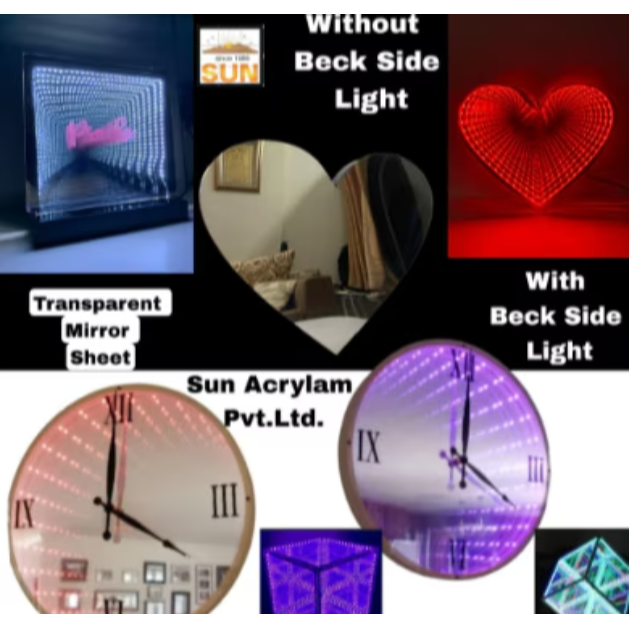
Conventional glass mirrors provide excellent reflection, but their weight and breakage risk can create limitations in certain interior, display, exhibition, and decorative applications. Acrylic mirror sheets offer a lightweight alternative where easy handling and visual impact are major priorities.
An Acrylic Mirror Sheet Manufacturer typically produces reflective sheets suitable for wall features, retail fixtures, event décor, children’s activity areas, signage, and fabricated products. Understanding their capabilities and limitations helps designers use them effectively.
Why Acrylic Mirror Is Different
An acrylic mirror is generally produced by applying a reflective layer to an acrylic sheet. It is significantly lighter than conventional glass and easier to cut into custom shapes.
The material can support creative forms such as:
- Decorative geometric panels
- Brand logos
- Reflective lettering
- Display inserts
- Ceiling accents
- Exhibition graphics
- Furniture details
- Themed interior installations
Its machinability allows fabricators to create shapes that may be more difficult or expensive to produce with glass.
Lower Weight Simplifies Installation
Weight is an important consideration for temporary exhibitions, portable displays, suspended features, and partitions. Acrylic mirror sheets can reduce the load placed on backing structures and mounting systems.
Lower weight also makes transport and on-site handling more manageable. This can be particularly useful for interior projects across Ahmedabad where prefabricated elements must be moved through occupied commercial spaces.
Even lightweight material requires secure mounting. The substrate, adhesive, panel dimensions, and environmental conditions must be considered before installation.
Better Suitability for Custom Shapes
Acrylic mirror sheets can be laser cut or routed into letters, motifs, borders, and intricate decorative elements. This flexibility supports customised interiors and branded environments.
However, the cutting method should be matched to the sheet type and backing. Incorrect processing can damage the reflective layer or create poor edge quality.
A prototype is advisable when a project includes fine details, tight internal corners, or very small components.
Important Flatness Considerations
Acrylic mirror does not always behave like a rigid glass mirror. If mounted on an uneven surface, it may reflect distortions. Larger sheets are more likely to reveal irregularities in the backing substrate.
For a cleaner result:
- Use a flat and stable base
- Avoid over-tightening fasteners
- Apply compatible adhesive evenly
- Allow for material expansion
- Keep the protective film in place during fabrication
- Remove masking only near completion
Where perfectly accurate reflection is essential, conventional glass may remain the more suitable choice.
Applications in Retail Environments
Retail designers use acrylic mirror to create depth, brightness, and visual interest without adding excessive weight. It can be installed behind products, inside display units, around shelves, or as part of promotional fixtures.
Smaller reflective elements are often more forgiving than large uninterrupted panels. Strategic placement can create a premium appearance while reducing the visibility of minor optical distortion.
Use in Children’s and Activity Spaces
Acrylic mirror is sometimes chosen for play areas, educational installations, activity walls, and sensory spaces because it is lighter and less prone to dangerous shattering than conventional glass.
That does not make every acrylic sheet automatically suitable for every safety-sensitive environment. Edge treatment, mounting security, thickness, accessibility, and applicable project standards should still be reviewed.
Colour Options Expand Creative Possibilities
In addition to silver-toned mirror sheets, decorative options may include gold, bronze, rose-gold, or other coloured reflective finishes.
Colour samples should be reviewed under the intended lighting. Warm LEDs, daylight, and retail spotlights can change the perceived tone of a reflective surface.
For multi-location rollouts, buyers should confirm batch consistency and retain an approved reference sample.
Care and Maintenance
Acrylic mirror surfaces require gentle cleaning. Abrasive cloths, harsh chemicals, and dry rubbing may cause scratches.
A soft microfibre cloth and compatible cleaning solution are generally more suitable. Cleaning instructions should be communicated to the facility or retail maintenance team after installation.
A capable Acrylic Mirror Sheet Manufacturer can help fabricators understand sheet size, colour availability, cutting compatibility, and protective handling requirements. Across Gujarat, the material is especially useful when a project needs reflective visual impact, customised shapes, and reduced installation weight without relying on heavy glass panels.