

Dim patches, bright LED dots, flicker, cloudy faces and warped corners can come from the acrylic, the letter geometry, the LEDs or the power system. You will be able to identify the visible defect, separate optical failures from electrical faults, specify the right construction and inspect finished letters before accepting them.
Key takeaways
- Match dark patches, haze and edge defects to their likely cause.
- Test LEDs, wiring and power before replacing acrylic letters.
- Specify face layers, letter depth and light distribution in writing.
- Inspect brightness, finish and weather resistance before accepting the sign.
Match the visible defect to its likely cause
A dark patch is a clue, not a reason to replace the whole sign. Match the appearance to the failure, then test the likely component. These checks help separate fluorescent acrylic letter defects from LED, wiring and fabrication faults.
1. Dim sections point to failed LED modules, voltage drop at a distant letter, blocked light paths, or dust and insects inside the cavity. A dirty interior absorbs light; condensation can scatter it and corrode connections. Measure voltage at the dim section before changing the face.
2. Uneven brightness usually means poor LED pitch, inconsistent diffusion, or a fluorescent face used without enough light recycling. Dark corners and centres indicate narrow strokes, deep returns or excessive cavity depth. LEDs too close to the face create visible hotspots.
3. Flicker indicates a loose connector, failing module or undersized power supply. Check polarity, cable joints and supply loading. Colour mismatch can come from different fluorescent sheet batches, LED colour temperature, or UV exposure that has faded one face.
4. A cloudy face suggests haze, adhesive transfer or moisture; scratches scatter light. Melted edges indicate cutting heat or flame-polishing damage, while warped letters indicate heat or poor support. Gaps at joins and light leakage expose inaccurate assembly, unsealed returns or missing backing. Loose or visible wiring signals poor routing or inadequate service access.
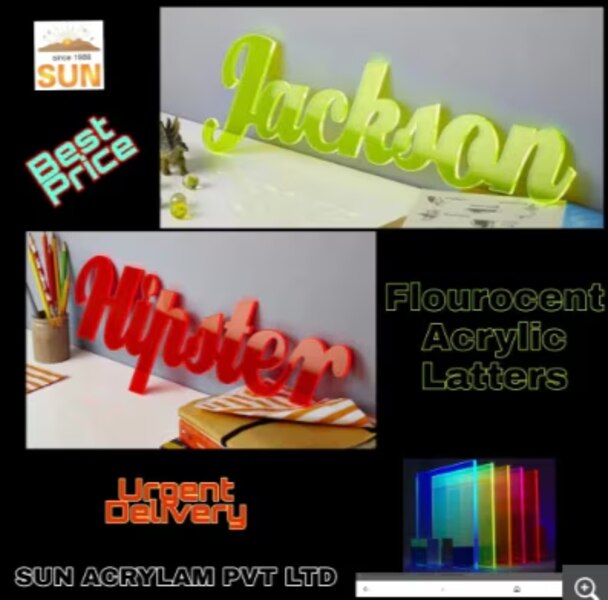
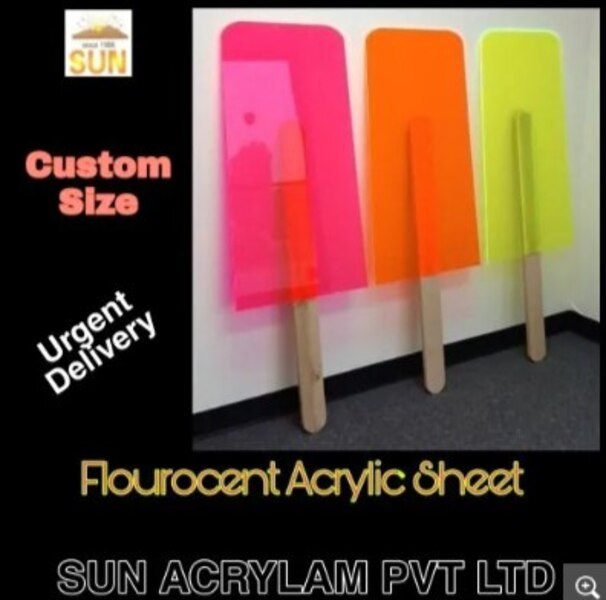
Fluorescent acrylic can look vivid in daylight but is not self-luminous: its pigments need an appropriate light source to produce strong glow. For neon acrylic for letter problems in ahmedabad, diagnose the light path before blaming the sheet.
Separate an acrylic fault from an electrical fault
Acrylic letters losing brightness need a controlled isolation sequence, not immediate face replacement. Start with the surface, then test voltage, connections, light path and heat in that order.
- Inspect the face in daylight, then compare the same letter unlit and illuminated. Haze, scratches, yellowing, UV fading and adhesive transfer indicate a surface or acrylic problem; a clean face that stays dark points elsewhere.
- Measure power-supply output, then measure voltage at the sign and at the farthest letter or LED module. Do not trust the voltage printed on the adapter. Record variation while the sign is operating.
- Inspect cable exits, connectors and polarity. Look for corrosion, condensation, dust, insects and water entry; ingress can absorb light, scatter it and damage modules.
- Bypass one dim LED section with a known-good section only when the circuit design permits it. If brightness returns, test the removed module, connector and cable separately.
- Compare the supply rating with the connected load. Run the sign continuously and check LED and supply temperature; heat-related flicker or dropout identifies a thermal failure.
| Variable | Clue | Likely direction |
|---|---|---|
| Interior | Dark, dusty or unpainted | Absorbs light; clean and refinish |
| Backing | White or high-reflectance | Improves light recycling, not LED spacing |
| Ambient heat | Brightness falls after operation | Thermal or supply fault |
| Solar loading | Daytime fade or heat | Face and enclosure stress |
| Ingress | Moisture or staining | Seal, drain and replace damaged parts |
A reflective interior cannot correct badly spaced LEDs or an insufficient cavity.
Specify letter geometry, face layers and light behaviour
Choose a minimum stroke width that fits the LED module footprint, wiring and service clearance; narrow strokes force LEDs too close to the face, creating hotspots. Narrow counters, small dots, tight curves, internal corners and deep returns restrict placement, producing shadows, dark centres or bright edges.
LED pitch has no universal value: module output, lens angle, cavity depth, diffuser transmission and viewing distance decide it.
- Use an opal diffuser, reflective interior or carefully designed cavity behind an intensely coloured fluorescent face.
- Blue-rich light can intensify fluorescent colour; UV-rich output accelerates fading and polymer degradation.
- Laser-cut heat-affected edges look frosted and produce a different halo from flame-polished edges, which look clearer but can carry thermal stress.
- Solvent cement and tight fixings can cause delayed crazing, especially near drilled holes, countersinks and stressed corners.
- Allow PMMA movement of about 70 × 10⁻⁶ m/m·K; rigid mounting can warp letters or crack holes as Ahmedabad heat and sun change temperatures.
| Face or construction | Light behaviour | Best use |
|---|---|---|
| Fluorescent acrylic | Saturated reflected colour; needs controlled illumination | Strong daytime colour |
| Translucent or opal acrylic | Spreads light and hides LED points | Even front illumination |
| Transparent coloured acrylic | Layers colour over internal components | Layered visual effects |
| Edge-lit acrylic | Illuminates edges rather than the face | Glowing outlines |
| Opaque-back acrylic | Blocks rear light and controls front output | Defined front illumination |
Dusty interiors, solar loading, heat, condensation and inconsistent sheet batches contribute to fluorescent acrylic lettering issues in ahmedabad; not every defect means the sheet failed. A white interior recycles light, but cannot fix bad spacing.
Choose the sign type and write a usable fabrication specification
Choose neon acrylic lettering for saturated colour and a shaped face, not for the simplest maintenance. It suits logos and display letters with controlled cavities; LED neon flex suits continuous linear forms and rounded strokes but is harder to service at tight letter details.
| Option | Brightness and finish | Installation, heat and service | Outdoor suitability |
|---|---|---|---|
| Neon acrylic letters | Uniformity depends on diffuser, LED pitch and cavity depth; offers custom colour and polished or diffused edges | Requires fabricated faces, wiring and access panels; heat must be managed | Suitable with sealed entries, drainage and correctly rated LEDs |
| LED neon flex | Smooth on continuous curves; tight details can show bends or shadowing | Fast to mount, low heat; replacing a damaged tight section is difficult | Use outdoor-rated flex, connectors and power supplies |
| Channel letters | Separated faces and returns make modules serviceable and brightness controllable | Adds depth, returns, brackets and hardware | Strong choice when access and weather protection matter |
| Non-illuminated acrylic | Even in daylight, with no electrical hotspots | Simplest installation and no electrical faults | Durable, but provides no night-time glow |
- Acrylic grade, thickness, face colour, diffuser or backing layer, letter depth and edge finish.
- LED colour temperature, spectral output, input voltage, LED spacing and power-supply rating.
- IP protection, mounting method, cable exit points, drainage and gasket or sealant practice.
- Original sheet batch information, plus warranty terms and replacement access.
SUN ACRYLAM PVT. LTD. can use this record to coordinate cutting, assembly and electrical access. For custom neon acrylic letters in ahmedabad, reject a quotation that specifies only “bright acrylic letters” without these measurable construction details.
Related products
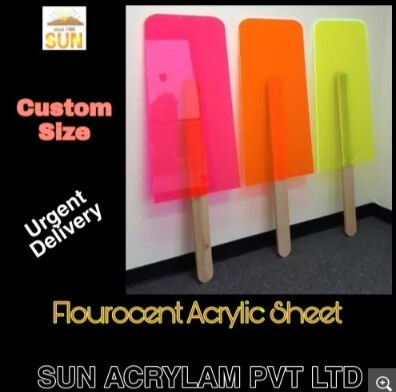 | Acrylic Mirror Letters Neon Acrylic Letters Fluorescent Neon Acrylic Letters Fluorescent View product → |
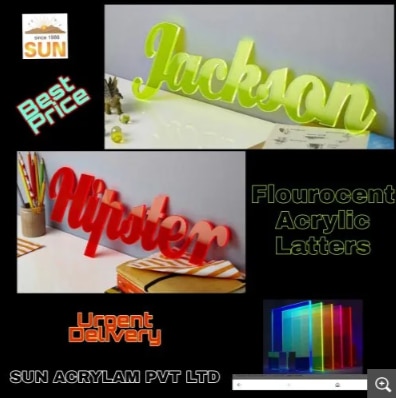 | Fluorescent Acrylic Sheets Fluorescent Acrylic Glass Letters Fluorescent Acrylic Glass Letters View product → |
Inspect brightness, finish and outdoor durability before acceptance
Approve only after a repeatable dusk test, not from a photograph. View the sign at its intended distance with fixed camera exposure, or measure luminance at agreed points across every letter. Put brightness variation, colour difference, visible LED-dot limits, joint gaps and light-leakage limits in the purchase order; no universal tolerance suits every design.
| Method | Strength | Use |
|---|---|---|
| Fixed-exposure photograph | Reveals visible differences without automatic brightening | Compare letters from the intended viewing distance |
| Luminance measurement | Produces repeatable readings at defined points | Set numerical brightness variation limits |
| Continuous operation | Exposes heat-related faults | Recheck flicker, overloaded supplies and failing modules |
Reject inconsistent brightness, visible LED points at the agreed distance, inaccurate face colour, rough rather than polished or intentionally diffused edges, proud joins, unstable mounting, exposed wiring, and rear or side leakage. These checks prevent neon acrylic lettering issues in Ahmedabad from being approved as a camera artefact.
For outdoor signs, inspect sealed cable entries, drainage, condensation, insects, dust, UV fading and the actual IP protection of LED modules. Clean with a soft, grit-free cloth and compatible mild detergent; ammonia cleaners, solvents, abrasive pads and dry wiping over dust cause scratches, whitening or gloss changes.
Remove protective film before heat, prolonged sunlight or final cleaning, following the sheet maker’s instructions. Retain the sheet grade, colour code, thickness, supplier batch and LED specification so a replacement face does not create a fluorescent colour mismatch.
Frequently asked questions
How do you identify the cause of a dark patch in neon acrylic lettering?
Match the visible defect to its pattern, then test the acrylic, LED modules, wiring and power supply separately.
How can you tell an acrylic defect from an electrical fault?
Inspect the surface and edges for haze, scratches or uneven diffusion, then check LED output, connections, voltage and illumination across the letter.
What details belong in a neon acrylic letter fabrication specification?
State the letter dimensions, depth, acrylic type and thickness, face layers, LED arrangement, light colour, diffuser treatment and mounting method.
What should you inspect before accepting an outdoor acrylic sign?
Check even brightness, clean edges, face finish, sealed connections, stable mounting and resistance to moisture and weather exposure.
Related products
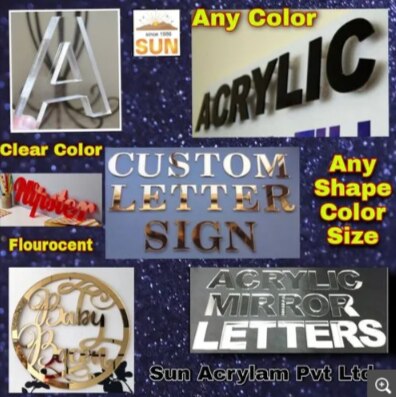 | Acrylic Mirror Letters Acrylic Letter Sign Custom View product → |
 | Cutting Services Acrylic 3d Letter View product → |